Bid the roof right.
Down to the square.
Measure the roof, price Good / Better / Best options with real margin, hand the customer a professional proposal — and turn the one they pick into a scheduled job. Without a spreadsheet, and without leaving money on the table.
Markup is not margin. The gap is your paycheck.
It is the easiest mistake in estimating to make, and the hardest to notice — because the job still looks profitable on paper. Same $10,000 of cost, same “30%”, two very different numbers.
That is $1,286 on a single ten-thousand-dollar roof. Run fifty of them a year and the arithmetic stops being academic.
Squares, pitch and waste — calculated in front of you
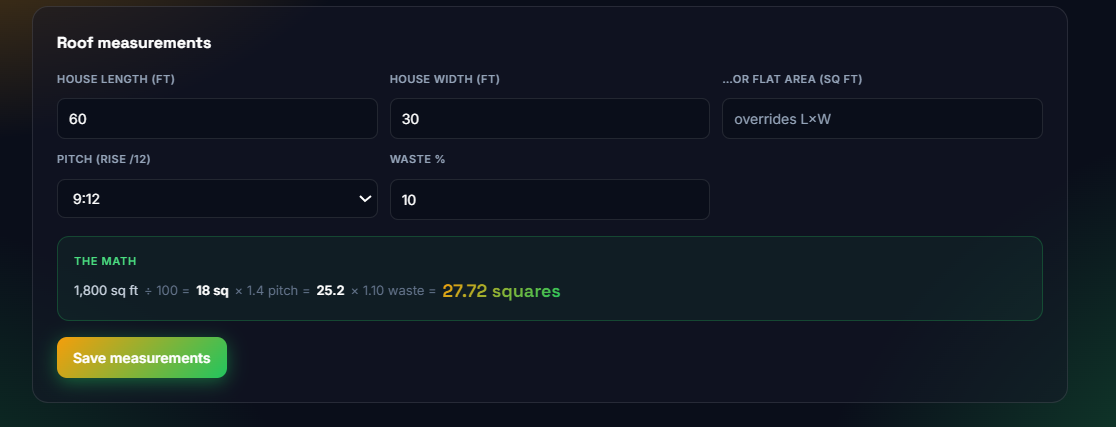
Enter the footprint or the flat area, pick the pitch, set your waste percentage. SiteWorks shows the whole calculation as you type, so you can sanity-check it before it becomes a price.
- Length × width, or enter a measured flat area directly
- Pitch multipliers from 3:12 to 12:12 applied automatically
- Your waste percentage, not a guess
- 1,200 sq ft at 5:12 with 10% waste = 16.37 squares, shown step by step
What you saw on the roof becomes the job
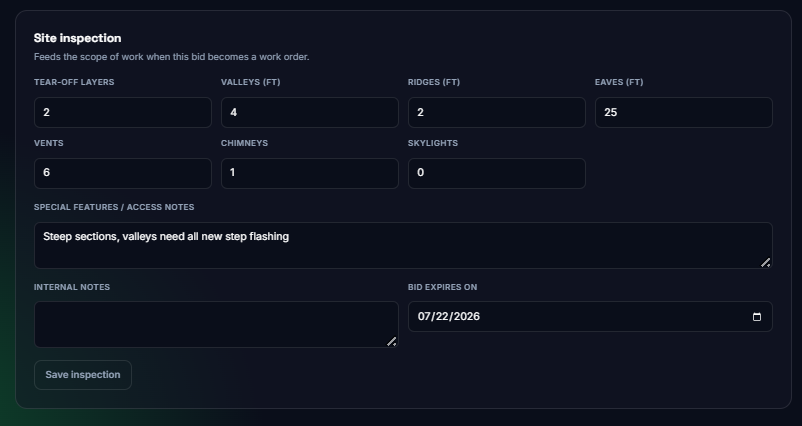
Record the tear-off layers, valleys, vents and access problems while you are standing there. When the bid is accepted, all of it carries into the work order as the scope — nobody retypes anything.
- Tear-off layers, valleys, ridges, eaves, vents, chimneys and skylights
- Access notes and special features captured on the bid
- One click from accepted bid to scheduled work order
- From there: crew time, photos, sign-off and the invoice
Give them three ways to say yes
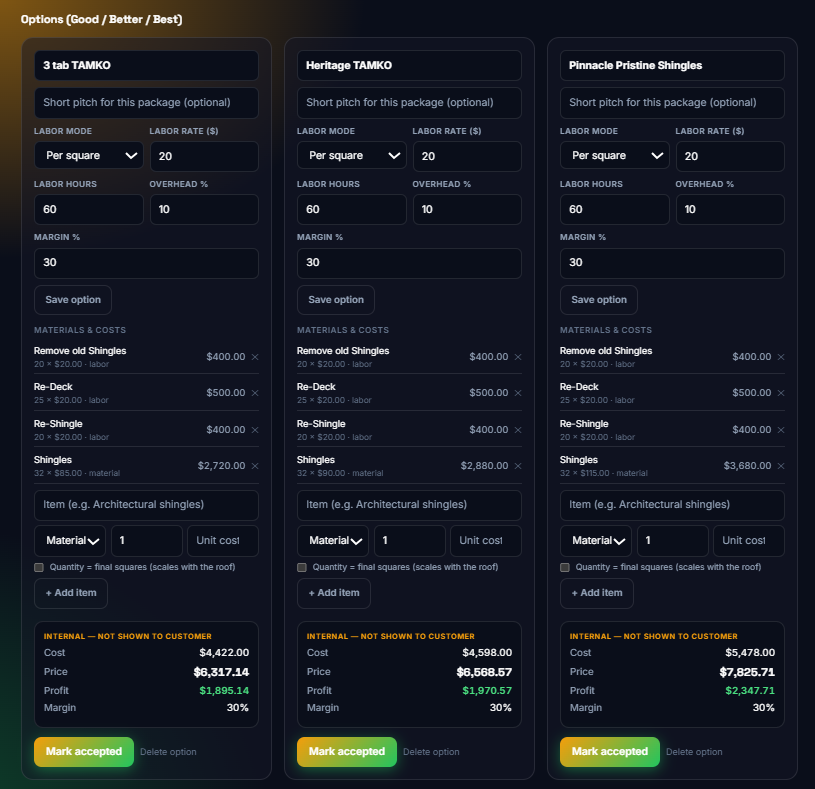
Build up to three packages on one bid — a straight tear-off, a better shingle, the full system with upgraded underlayment. Each carries its own materials, labor and margin, and you see cost, price, profit and true margin on every one.
- Up to three options side by side on a single bid
- Per-square, flat or hourly labor per option
- Cost, price, profit and margin per option — internal only
- Mark the winner and the bid locks to it
A proposal that looks like you meant it
Export a clean PDF with the options, what each one includes, and the price. Your costs, overhead and margin never appear on it — that stays on your side of the table.
- Options presented side by side with what is included
- Labor shown as a single line, never itemized against you
- No unit costs, no margin, no internal numbers — by design
- Roof summary in squares, plus your terms and expiry
Everything else the bid needs to do.
Bring us a roof you already bid. We’ll price it live.
Bring the measurements from a job you quoted last month and we’ll build it in SiteWorks on the call — options, margin and proposal. Then you can decide whether the number you sent was the number you meant.